


Poultry
Our Feathered Friends
Our feathered animals play an important role on the farm - not only as part of food production, but also in maintaining balance within our environment. Free-ranging during the day and safely housed at night, they contribute naturally to pest control while adding life and movement around the farmyard.
Turkeys
Our turkeys were introduced as part of a natural pest-control system and have since become a valuable part of the farm. During the day, they roam freely around the homestead and surrounding areas, actively foraging and interacting with their environment. At night, they are securely housed to protect them from predators such as civets and genets.
Turkeys are larger and more robust than chickens, which allows them a greater level of self-protection when free-ranging. Their size, awareness, and group behaviour make them effective at deterring certain pests and unwanted wildlife. They are known to forage for insects, larvae, small reptiles, and other pests, helping to keep the area around the homestead balanced.
Historically, turkeys originate from North America, where they were first domesticated by indigenous peoples long before European settlement. Over time, they became valued worldwide for both their meat and adaptability. Turkeys are hardy birds when managed in open systems that allow movement and natural behaviour.
While turkeys are also known for their eggs, we allow ours to incubate naturally rather than harvesting the eggs. This supports natural breeding cycles and flock sustainability.
Our turkeys are raised with the intention of responsible meat production, always prioritising animal welfare and natural living conditions. They may be available for meat or as live birds depending on the season - get in touch to enquire about availability and pricing.

Chickens
Chickens were introduced primarily to address fly pressure around the goat kraals - a challenge common on livestock farms. Since bringing them onto the farm, fly numbers have decreased significantly, highlighting the effectiveness of chickens as natural pest controllers.
Our chickens free-range throughout the day, actively scratching, foraging, and feeding on insects and organic matter. In the late afternoon, they receive supplementary feed to ensure balanced nutrition. This free-range system allows them to express natural behaviours while contributing meaningfully to the farm ecosystem.
In addition to pest control, the chickens provide a consistent supply of fresh eggs. Free-range eggs are widely valued for their richer yolk colour and flavour, often linked to a more varied, natural diet and increased movement.
Chickens have been farmed by humans for thousands of years and remain one of the most versatile and adaptable farm animals. Their ability to integrate seamlessly into mixed farming systems makes them an essential part of sustainable agriculture.

Indian Runner Ducks
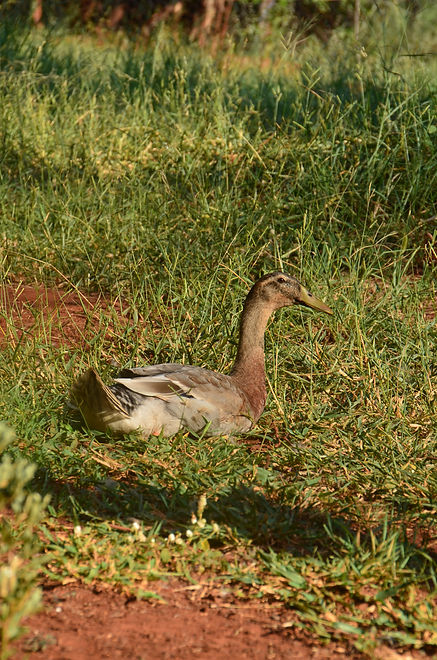
Our duck flock consists of Indian Runner ducks, a breed well known for its exceptional foraging ability and distinctive upright posture. Originally developed in Southeast Asia, Indian Runner ducks were traditionally used in rice paddies to control pests without damaging crops.
Like the turkeys and chickens, our ducks were introduced primarily for pest control. They free-range around the homestead during the day and have access to a small water pool where they can swim, clean themselves, and cool off. Ducks are particularly effective at controlling insects, snails, slugs, and other small creatures - their enthusiasm for foraging is impressive and constant.
Indian Runner ducks do not nest or brood in the same way as chickens or turkeys. Instead, they tend to lay eggs sporadically in various spots throughout their grazing areas.

Duck eggs differ from chicken eggs in several ways. They are typically larger, have thicker shells, and are known for their rich flavour and higher fat content. While we do not actively collect duck eggs, they remain an interesting and valuable part of the breed’s characteristics.